Showing posts with label authors. Show all posts

Thursday, January 21, 2016

Mike Long on Comedy, Writing and Physics

http://www.aps.org/careers/physicists/profiles/long.cfm


Excerpt from the article above on Advice for Students:

Advice for Students

Physics is a Life Skill
“You may love physics, and just not know it,” Mike says. “If you crave order, if you imagine there is more to the world than mere opinion, it’s the way to go. What distinguishes it from other sciences is that it ultimately it teaches you how to think- if you can master the technique of learning physics, you can learn pretty much anything, and it will make you better at whatever you want to do.” 

Enjoy Your Work
“When you pick a career, the only question you should ask is ‘what looks like fun?’” Mike says. “The goal is to get up in the morning and do what you like. So many people say, ‘I’m going to find something that makes enough money so I can enjoy the rest of my time’- and that’s just a terrible mistake. You have to integrate your love with your work.” 

Don’t Rule Out Options
Mike initially ruled out writing as a career because he didn’t know if it was a practical career option. He leaned towards physics and biology because even though he didn’t know many professional scientists, he knew the sciences were thriving, mentally-challenging fields with many job opportunities. 

Regardless of what fields or subjects you are interested in, if you aren’t familiar with available career options, don’t rule them out. Research about them online and reach out to possible mentors. 
“If you really truly love it with your heart…find a way to do it,” Mike says. “The very best thing you can do is get paid to be yourself.”

Monday, January 18, 2016

Reading Pulp Fiction Online with Links

http://www.blackmaskmagazine.com/notchedgun.html Walt Coburn

Library of Congress Pulp Fiction

Pulp Magazines Project

From the site:
The Pulp Magazines Project is an open-access archive and digital research initiative for the study and preservation of one of the twentieth century's most influential print culture forms: the all-fiction pulpwood magazine. The Project also provides information and resources on publishing history, multiple search and discovery platforms, and an expanding library of high-quality, cover-to-cover digital facsimiles.

Sunday, August 30, 2015

Cleared for take-off: Pilot finds second career as author - Tulsa World: Whatareyou

Cleared for take-off: Pilot finds second career as author - Tulsa World: Whatareyou

What Are You?

From Tulsa World:
Erin Chappel logged 20 years in her former profession. Then came what she described as the “dark days.”


Chappel said she was lost after retiring, or at least as lost as you can get in a pumpkin aisle.


“I would be, like, in Hobby Lobby every day checking out the pumpkins, trying to figure out what the heck to do with myself,” she said.


“After a long stint of that, my husband said, ‘You know what, I think you are depressed, and you need to figure out what is going on.’ At that very moment, I knew that I needed to do something different.”

Writer Clay McLeod Chapman: Tom Robbins Description

Clay McLeod Chapman


Text is Tom Robbins:  Clay McLeod Chapman "Like a demonic angel on a skateboard, like a resurrected Artaud on methadrine, like a tattletale psychiatrist turned rodeo clown, Clay McLeod Chapman races back and forth along the serrated edges of everyday American madness, objectively recording each whimper of anguish, each whisper of skewed desire. This is strong stuff, intense stuff, sometimes disturbing stuff, but I think the many who admire Chuck Palahniuk will admire Chapman as well."—Tom Robbins, author, Still Life with Woodpecker

Check out more information about his author at his website: http://claymcleodchapman.com/

Monday, August 17, 2015

Larry Brown's Writing Shack in Tula, Mississippi

http://hottytoddy.com/wp-content/uploads/2015/04/Photo-21.jpg


I have been a fan of Larry Brown's writing for a long time.  I recently found some pictures of his writing shack.   Larry Brown built the tiny cabin on land, and documented the project in his book entitled: "Billy Ray's Farm".

It is a very well written nonfiction account of Larry's life.  He passed away at way too early of an age, but I still feel like his legacy lives on in his words.
This spot and the tiny cabin look like the perfect place to get away from it all, and for writing and reflecting.

Larry Brown - A fine line and "Conversations with Larry Brown" Book


The author's thoughts on writing honestly.

One of things my students and I have noticed most about his interviews would have to be the accent. Every time I hear Larry Brown it makes me wish I could have bought the dude a beer or two when he was still alive.   I have revisited much of his writing, and even purchased a book that has all of his interviews compiled into one volume:

"Conversations with Larry Brown"   Click the link to go to Amazon and have a look inside.


Friday, July 10, 2015

Outline or Not? | Joseph Finder and Author Video on Writing

 Video on Writing

Outline or Not? | Joseph Finder

Text excerpt from Joseph Finder:


Outline or Not?

Okay, you’ve finally decided to sit down and write a thriller. As Robert Redford asked in the last line of The Candidate: “Now what?”

Outline or not?

This is the question I get most of all, whether by e-mail or at conferences: Do you outline or not?

It’s a good and important question, and here’s the thing: There’s no Right Answer. All of us writers make up our own rules as we go along. There’s no one way to do it.

Ask Harlan Coben, and he’ll tell you no way, he doesn’t outline, but he does know the ending before he starts. He says, “It’s like driving from New Jersey to California. I may go Route 60, I may go via the Straits of Magellan or stop over in Tokyo . . . but I’ll end up in California.”

Ask John Grisham, and he’ll tell you he can’t write a novel without doing an outline first. He does a 50-page outline with a paragraph or two about each chapter, setting out the major events and plot points. He spends more time on the outline than on the writing. Robert Ludlum once told me the same thing — his outlines were often as long as 100 or 150 pages!

I once got into a public dispute with my friend Lee Child — well, it being Lee Child, it was cordial and amicable and polite, of course — who said he never outlines, and I should try it his way.

So I did. I mean, I’m a top ten New York Times bestseller (polite cough into fist), but Lee’s had repeated #1’s, so he must know what he’s doing, right?

Just Write the Damned Book Already | Joseph Finder

Just Write the Damned Book Already | Joseph Finder


Thrillers to Learn From | Joseph Finder

Thrillers to Learn From | Joseph Finder

Text excerpt from Joseph Finder via the link above:

Thrillers to Learn From


I gave a talk a couple of months ago at Muse and the Marketplace, the terrific annual writers conference sponsored by Grub Street in Boston, where I listed the best books to learn thriller-writing from — a few nonfiction books, but mostly great thrillers that I think every thriller writer should read and take notes from. I’ve received loads of requests to put this list online.


Here it is, my list of the thrillers you

 need to read if you’re an aspiring thriller writer (or just want to read some great suspense novels):
Peter Abrahams, The Tutor. Mom and Dad hire an SAT tutor for their slacker son. Turns out he’s the tutor from hell. Abrahams is one of the best writers around.
James M. Cain, The Postman Always Rings Twice. Sounds old-fashioned, right? Nope. Apart from some dated slang, the language is crisp and timeless, and the story is fast and furious and unfolds like a Greek tragedy.
Lee Child, Persuader. Reacher is a great series hero, and Lee Child’s dry, crackling prose is among the best in the business. The opening to Persuader is one of the best, most cleverly worked out thriller openings I’ve ever read.
Michael Crichton, Jurassic Park and Disclosure. Two very different books of his: I’ve always admired the way he incorporates research and complicated technical detail without slowing down the pace; on the contrary, all that stuff heightens the intrigue.
Harlan Coben, Tell No One. Irresistible hook, great voice, twist after twist after twist.
Nelson DeMille, The Gold Coast. One of my favorites. More of a straight “novel” than a thriller, but this, along with all of DeMille’s books since then, is a model of how to incorporate humor and attitude into your storytelling without diminishing the suspense.
Ken Follett, The Eye of the Needle. Hits on all cylinders: plot, pacing, love story, narrative momentum, and characters — especially a great, interesting villain.
Frederick Forsyth, The Day of the Jackal. I think I’ve gone through three paperback copies already. Forsyth is no great stylist, but that’s not a disadvantage here: it reads like a documentary in novel form. Plausible, realistic, authoritative, really exciting. Wonderfully executed. A classic.
William Goldman, Marathon Man. This is the one that has influenced more thriller writers working today than any other, whether they admit it or not. Why? The voice – slangy, casual, intimate, fresh. The twists you don’t see coming. Fast, stripped down, elegant, powerful.
John Grisham, The Firm. A great hook, told with economy and relentless pace.
Robert Harris, The Ghost. It’s all in the telling – Harris, an elegant writer, ratchets up the suspense with hardly any violence or bloodshed. Also a great book about writing.
Thomas Harris, Red Dragon and Silence of the Lambs. Red Dragon is one of the scariest books you’ll ever read, and Silence of the Lambs is more than Hannibal Lecter. Harris is also a wonderful writer who knows how to do exposition and incorporate detail in a completely natural way. Check out the brilliantly choreographed escape sequence, chapters 36 to 38.
Anthony Hyde, Red Fox. For some reason, this is all but forgotten. But it’s excellent – spare prose, linear story line, with each revelation leading to the next, and extremely atmospheric.
John le Carre, The Spy Who Came In From the Cold. A simple, fable-like story, told with grace and power. It reinvented the spy novel.
Ira Levin, Rosemary’s Baby and The Boys From Brazil. As far as I’m concerned, nobody in my line of work ever did it better. Very different plots, but each is the work of an unsurpassed, understated, yet incredibly elegant prose writer. No wonder Stephen King said of Levin: “Every novel he has ever written has been a marvel of plotting. He is the Swiss watchmaker of the suspense novel; he makes what the rest of us do look like those five-dollar watches you can buy in the discount drug stores.”
David Morrell, First Blood. Forget whatever you think about Sly Stallone and Rambo. This book is a now-classic chase novel, a mano à mano confrontation between a damaged Vietnam vet and a sheriff, and you won’t be sure whom to root for.
Scott Turow, Presumed Innocent. Amazing: melancholy, a tmospheric, a first person unreliable narrator, a plot that unspools masterfully.
Donald Westlake, The Hook. Classic tale of two writers in NYC, one “literary” and one “commercial,” and a murder that involves them both.


And a few non-fiction titles; most “how to” books aren’t much use, but I’ve found these helpful:


Stephen King, On Writing.
Robert McKee, Story. This is directed at screenwriters, but it’ll teach a novelist a useful and whole new way of looking at story structure.
Al Zuckerman, Writing the Blockbuster Novel. Some of Zuckerman’s examples are out of date, but the basics remain, and it’s very smart.

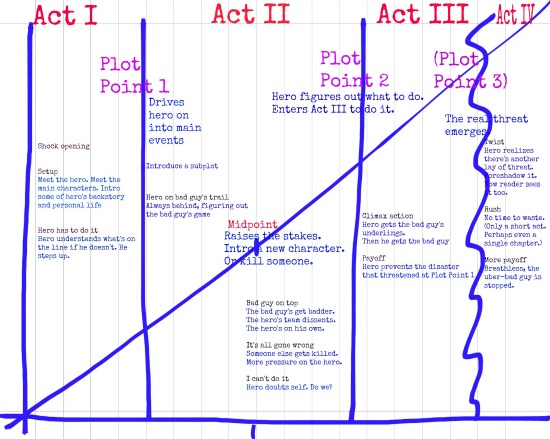
Plot A Thriller Diagram: Matt Rees Writing Techniques


Text excerpt written by Matt Rees:


This diagram is a framework for writing a thriller. It’s based on my experience writing crime fiction and on studying how other writers create thriller plots. I’ll go into more detail about each of the stages of the diagram in future posts on thriller plot structure and thriller plot twists, and I’ll add some points to the diagram as we go along. But if you follow this to create your thriller plot outline, you’ll have a thriller that’ll keep you and your readers in a state of tension until the last page. It’s a companion piece to my podcast How to Structure and Plot a Book. While you’re waiting for my coming posts, come up with a premise for a thriller and see if you can plot out how you’d develop it right through this diagram. Before you know it you’ll have a basic thriller plot. Let me know what you come up with.

The 5 C's of Writing a Great Thriller Novel | WritersDigest.com

The 5 C's of Writing a Great Thriller Novel | WritersDigest.com


Here is a very helpful article for any writers interested in crafting the next best selling thriller novel:


The 5 C’s of Writing a Great Thriller Novel

Tuesday, July 7, 2015

Jack Reacher Character Explained: Description of Lee Child's Famous Hero

via http://www.leechild.com/jack-reacher.php


Jack-Reacher-AWM
  • Name
  • Born
  • Measurements
  • Hair
  • Eyes
  • Clothing
  • Jack Reacher
  • October 29
  • 6'5", 220-250 lbs., 50" chest
  • Dirty-blond
  • Ice Blue
  • 3XLT coat, 95 cm. pants' inseam

BIO
FAMILY
KNOWN ASSOCIATES


Reacher left home at 18, graduated from West Point. Performed 13 years of Army service, demoted from Major to Captain in 1990, mustered out with the rank of Major in 1997.

“I was born in Berlin. Never even saw the States until I was nine years old. Five minutes later we were in the Philippines. Round and round the world we went. Longest I was ever anywhere was four years at West Point. Then I joined up and it started all over again. Round and round the world.”

“Where’s your family now?” she asked.

“Dead,” he said. “The old man died, what? Ten years ago, I guess. My mother died two years later. I buried the Silver Star with her. She won it for me, really. Do what you’re supposed to do, she used to tell me. About a million times a day, in a thick French accent.”

“Brothers and sisters?” she said.

“I had a brother,” he said. “He died last year. I’m the last Reacher on earth, far as I know.”

“When did you muster out?” she said.

“April last year,” he said. “Fourteen months ago.”

“Why?” she asked.

Reacher shrugged.

“Just lost interest, I guess,” he said. “The defense cuts were happening. Made the Army seem unnecessary, somehow. Like if they didn’t need the biggest and the best, they didn’t need me. Didn’t want to be part of something small and second-rate. So I left. Arrogant, or what?”

In TRIPWIRE, Jodie (Jodie Garber, KNOWN ASSOCIATES tab above) noted “His lazy lopsided grin. His tousled hair. His arms, so long they gave him a greyhound’s grace even though he was built like the side of a house. His eyes, cold icy blue like the Arctic. His hands, giant battered mitts that bunched into fists the size of footballs.” Reacher has a scar on his arm where his brother struck him with a retaliatory chisel (see FAMILY tab above, Brother: Joe).

Born on an Army base in Germany. His father chose his name; it read “Jack-none-Reacher” on the birth certificate faxed to the Berlin Embassy. They called his brother Joe, but nobody ever called Jack by his first name. How it came about, no one knows but Jack was always called Reacher.

As kids, Jack and his brother moved so much that spending a full school year in any one place felt weird. “Our friends just kept disappearing. Some unit would be shipped out somewhere and a bunch of kids would be gone. Sometimes we saw them again in a different place. Plenty of them we never saw again. No
body ever said hello or goodbye. You were just either there or not there.”


Service Awards (circa 1990):
Top row: Silver Star, the Defense Superior Service Medal, the Legion of Merit
Second row: Soldier’s Medal, the Bronze Star, the Purple Heart
Bottom row: “Junk awards”

“Medals?” she asked.
He shrugged.
“Dozens of the damn things,” he said. “You know how it is. Theater medals, of course, plus a Silver Star, two Bronzes, Purple Heart from Beirut, campaign things from Panama and Grenada and Desert Shield and Desert Storm.”
“A Silver Star?” she asked. “What for?”
“Beirut,” he said. “Pulled some guys out of the bunker.”
“And you got wounded doing that?” she said. “That’s how you got the scar and the Purple Heart?”
“I was already wounded,” he said. “Got wounded before I went in. I think that was what impressed them.”

What he doesn’t have: A driver’s license, Federal benefits (doesn’t want them), tax returns (doesn’t do them; he hasn’t filed taxes since he left the Army).

Lee Child Debunks Writing Myths: How do you create suspense?

http://www.writersdigest.com/whats-new/lee-child-debunks-the-biggest-writing-myths

Here is an excerpt:


For instance: Suspense is created by having sympathetic characters. More and more, Child said, this rule doesn’t add up. Case in point: In The Runaway Jury by John Grisham, Child said there isn’t a sympathetic character in the entire book—there are bad guys, and worse guys. Instead of sympathetic characters, the book is driven by what the verdict of the trial at the heart of the story will be.

“And that’s how you create suspense,” he said—it all boils down to asking a question and making people wait for the answer.

Child added that one thing he has learned throughout his career as a television writer and novelist is that humans are hard-wired to want the answer to a question. When the remote control was invented, it threw the TV business through a loop. How would you keep people around during a commercial? So TV producers started posing a question at the start of the commercial break, and answering it when the program returned. (Think sports—Who has the most career grand slams?) Even if you don’t care about the answer, Child said, you stick around because you’re intrigued.

Ultimately, he said writing rules make the craft more complicated than it really is—when it comes down to it, it’s a simple thing.

“The way to write a thriller is to ask a question a the beginning, and answer it at the end,” he said.

When he’s crafting his books, Child doesn’t know the answer to his question, and he writes scene by scene—he’s just trying to answer the question as he goes through, and he keeps throwing different complications in that he’ll figure out later. And that very well may be the key to his sharp, bestselling prose.

“For me the end of a book is just as exciting as it is for a reader,” he said.

- See more at: http://www.writersdigest.com/whats-new/lee-child-debunks-the-biggest-writing-myths#sthash.oMJZGdxy.dpuf


Tuesday, June 30, 2015

Author Tom Robbins: Interviews and Links

Tom Robbins Link Historylink.org-Article about Tom Robbins that includes his early years, the individual books he has written, and a plethora of other information. It is by By Michael Hood, May 15, 2003.*


*Licensing: This essay is licensed under a Creative Commons license that encourages reproduction with attribution. Credit should be given to both HistoryLink.org and to the author, and sources must be included with any reproduction. Click the icon for more info. Please note that this Creative Commons license applies to text only, and not to images. For more information regarding individual photos or images, please contact the source noted in the image credit.


A Letter from Tom Robbins and the importance of connecting via:
http://lifedonewrite.com//reached-tom-robbins-look-happened-benefits-connecting-someone-havent-never/

Great quotes from one of Tom Robbins novels:
quotes from-still-life-with-woodpecker via goodreads


Jack Reacher Books: Suggested Reading Order(s)-Lee Child


Jack Reacher Books In Order: List of Reacher Novels by Publishing Date


You have 3 choices when choosing the reading order for Jack Reacher books:
  1. By Publishing Date
  2. In Chronological Order
  3. No Order At All: Complete Chaos

Want To Read The Jack Reacher Books In Order Of Publishing Date?

I recommend this order myself.
  1. Killing Floor (1997)
  2. Die Trying (1998)
  3. Tripwire (1999)
  4. Running Blind (2000)
    • UK Title “The Visitor”
  5. Echo Burning (2001)
  6. Without Fail (2002)
  7. Persuader (2003)
  8. The Enemy (2004)
    • Prequel set eight years before Killing Floor
  9. One Shot (2005)
  10. The Hard Way (2006)
  11. Bad Luck and Trouble (2007)
  12. Nothing to Lose (2008)
  13. Gone Tomorrow (2009)
  14. 61 Hours (Spring 2010)
  15. Worth Dying For (Fall 2010)
  16. The Affair (2011)
    • This is another prequel set just before Killing Floor
  17. A Wanted Man (2012)
  18. Never Go Back (2013)
  19. Personal (2014)
  20. Make Me (2015)

Want To Read The Jack Reacher Novels In Chronological Order?

  1. The Enemy (2004)
    • Prequel set eight years before Killing Floor
  2. The Affair (2011)
    • This is another prequel set just before Killing Floor
  3. Killing Floor (1997)
  4. Die Trying (1998)
  5. Tripwire (1999)
  6. Running Blind (2000)
    • UK Title “The Visitor”
  7. Echo Burning (2001)
  8. Without Fail (2002)
  9. Persuader (2003)
  10. One Shot (2005)
  11. The Hard Way (2006)
  12. Bad Luck and Trouble (2007)
  13. Nothing to Lose (2008)
  14. Gone Tomorrow (2009)
  15. 61 Hours (Spring 2010)
  16. Worth Dying For (Fall 2010)
  17. A Wanted Man (2012)
  18. Never Go Back (2013)
  19. Personal (2014)
  20. Make Me (2015)

Monday, April 20, 2015

"Taking the Mystery Out of Writing Mysteries": Informative Article by Dennis Palumbo

Full Article by Dennis Palumbo

The following italicized sections are from the article and I posted them because they contain some great brainstorming questions for beginning a mystery novel. Please click the link above to review the article in its entirety.
For me, there's only one answer: ask yourself, what makes you unique? What scares you, interests you, makes you angry? What do you yearn for, or wish to avoid? What are your hobbies, passions? What's the aspect of your own character about which you're most conflicted, unhappy, even embarrassed? Believe it or not, this is where the seeds of an interesting, unusual protagonist are first sewn.


AND

So why don't you start by making a list of your own traits and interests, as suggested above? The closer the hero or heroine of your mystery story is to you, the more vivid and engaging he or she will be to the viewer. After all, as Emerson said, "To know that what is true for you in your private heart is true for everyone - that is genius."


Next, let's look at the world of your mystery story. What is the world you inhabit? Suburban soccer mom or single father? Former football coach, magazine editor, or Rhodes scholar? Travel agent, computer specialist, or kindergarten teacher?


After all, you know the details of your particular world so clearly. You know the ins and outs. It's those details that create the backdrop for the crime, that make possible the intrigue, the collision of misleading, back-stabbing, or too-good-to-be-true characters. Think of the gambling background in the movieOcean's 11. Or that of the legal profession in The Firm.

How to Write a Mystery Novel Link and Iron Lake by William Kent Krueger Symbols

windigo
I found this Link to Random House, "How to Write A Mystery Novel", and found it to be quite an interesting formula.  I just finished reading "Iron Lake" by William Kent Krueger and was very impressed with the format of the mystery novel.  I was also impressed by the setting. WK Krueger is a Oregon native but has been living in St. Paul for many years.  He has definitely done his research concerning Minnesota and how to incorporate symbols from the state into his writing.  "Iron Lake" is his first novel in the Cork O'Connor series and it is filled with many elements that will appeal to readers interested in learning about Minnesota. He write about many Ojibwe beliefs and does a great job at creating diverse American Indian characters.

He begins the novel with a mystery but also gives readers some background concerning the main character Cork.  Cork grew up with a very wise American Indian elder to guide him in the ways of the woods. This character also teaches him about the mysteries associated with the Minnesota forest, and the windigo element that continues throughout this novel.

Other Ojibwe American Indian symbols found in this book:
Sweat lodge, Sauna, genocide, gambling, buffalo, casino, hunting, courage, bravery

Witch Tree
Medicine Man-Midewiwin
Check out this introduction to Ojibway Culture and History page for more information.

Sunday, April 12, 2015

The man who shot Charles Bukowski

The man who shot Charles Bukowski


Watched "The Big Lewbowski" on Netflix the other night.  Just a few too many similarities with Charles Bukowski, the genius poet and author.  He was the most entertaining poet in the last two hundred years.

Tuesday, March 17, 2015

Link to Interview with Author Daniel Woodrell

https://litreactor.com/interviews/a-conversation-with-daniel-woodrell


Check out this great interview with Missouri author Daniel Woodrell.  He is the author of many novels and short stories.  His books deal with life in Southern Missouri and many readers place them in the crime and thriller genre.  I learned about his writing from an episode of "No Reservations" with Anthony Bourdain. I have been a fan of Bourdain's shows and writing for quite some time, and I enjoy getting a chance to check out the authors he recommends. I wasn't disappointed by the work of Woodrell and would love to read more of his writing.  Check out the link above for a great a interview by lit reactor with the novelist.


Here is another link to information on author Daniel Woodrell via Narrative Magazine.  They also have a couple of his short stories that you can read for free online.

Tuesday, March 10, 2015

Jim Harrison, Men's Journal - Season of the Wolf: 1994

Great article on Jim Harrison from back in the year of my high school graduation, 1994:  
Here is the link and some pictures from the original article below:


From the article, " As we descend on the other side of the Patagonias, the air is cool and the landscape is lovely, green in the pine trees but otherwise sheathed in shades of black and brown. Harrison stops here and there to point out sites that figure in "The Beige Dolorosa," one of the novellas in his new book. Psychological healing is often a theme in his work now. The lead character in that story is a college professor whose life falls apart and who winds up on a ranch near Patagonia, learning to ride and do physical work and take walks in the mountains and change his life."