Showing posts with label writing education. Show all posts

Thursday, January 21, 2016

Mike Long on Comedy, Writing and Physics

http://www.aps.org/careers/physicists/profiles/long.cfm


Excerpt from the article above on Advice for Students:

Advice for Students

Physics is a Life Skill
“You may love physics, and just not know it,” Mike says. “If you crave order, if you imagine there is more to the world than mere opinion, it’s the way to go. What distinguishes it from other sciences is that it ultimately it teaches you how to think- if you can master the technique of learning physics, you can learn pretty much anything, and it will make you better at whatever you want to do.” 

Enjoy Your Work
“When you pick a career, the only question you should ask is ‘what looks like fun?’” Mike says. “The goal is to get up in the morning and do what you like. So many people say, ‘I’m going to find something that makes enough money so I can enjoy the rest of my time’- and that’s just a terrible mistake. You have to integrate your love with your work.” 

Don’t Rule Out Options
Mike initially ruled out writing as a career because he didn’t know if it was a practical career option. He leaned towards physics and biology because even though he didn’t know many professional scientists, he knew the sciences were thriving, mentally-challenging fields with many job opportunities. 

Regardless of what fields or subjects you are interested in, if you aren’t familiar with available career options, don’t rule them out. Research about them online and reach out to possible mentors. 
“If you really truly love it with your heart…find a way to do it,” Mike says. “The very best thing you can do is get paid to be yourself.”

Thursday, November 12, 2015

Get plot right: Lessons from 7 bestsellers

Get plot right: Lessons from 7 bestsellers


I could see this information as being pretty helpful, as most of the best sellers are not that well written and they are usually pretty quick reads. Maybe writing the next best seller is as easy as stealing a plot from one of the major mass market paper back writers, and inserting interesting characters.

Here is the list: (Click the link above for the entire article)


The Davinci Code by Dan Brown


The Girl with the Dragon Tattoo by Steig Larssen


The Thirteenth Tale by by Diane Setterfield

Diane Setterfield’s first novel became a best seller immediately after its release in 2006 and was made into a film by the BBC in 2013. The Thirteenth Tale hearkens back to its gothic predecessors. The plot itself shifts between past and present as the protagonist uncovers the family secrets of a famous novelist.

While the book’s structure and the particulars of its plot are original, the success of The Thirteenth Tale indicates that newness is not always what the public is seeking. Old-fashioned melodrama abounds in The Thirteenth Tale, and with its backdrop of antiquarian bookselling and echoes of nineteenth century classics, it is almost a polar opposite to the contemporary concerns of Girl With the Dragon Tattoo. What it shares with that, and other bestsellers, is a number of plot twist and unpredictable revelations that grip the reader.

The Historian by Elizabeth Kostova

Kostova’s 2005 novel The Historian quickly became the fastest-selling first novel in U.S. publishing history. Kostova based her story on the historical Vlad Tepes and the literary Count Dracula as she related the tale of a professor and his daughter in search of Tepes’ tomb.

The book includes lush descriptions of the many European countries in which it is set. Like The Da Vinci Code, it draws on a literary and historical background that most readers have a passing familiarity with and gives the reader a sense of access to secrets and historical details formerly concealed. Like several other bestsellers, secret histories and discoveries create an interest and make the book a page-turner. Unlike The Da Vinci Code but like The Thirteenth Victim, the time scope of The Historian is huge, set across three major periods in the twentieth century.

Another best-seller that occurs across a broad swathe of the twentieth century is one by South African writer Lauren Beukes:

The Shining Girls by Lauren Beukes

The serial killer is an ever-popular trope in thrillers and crime fiction, but Beukes marries it to time travel in her 2013 novel, later optioned by actor Leonardo di Caprio’s production company. The Shining Girls tells the story of one who seeks out young women to murder in order to maintain his connection with the time-travelling house he has stumbled into. What Beukes gets right in The Shining Girls is injecting something fresh into well-worn storytelling tropes such as serial killers with female victims.

The Girl on the Train by Paula Hawkins

Monday, August 17, 2015

10 Ways to Harness Fear and Fuel Your Writing: My favorite writing prompts

10 Ways to Harness Fear and Fuel Your Writing | WritersDigest.com

Check out the link above for more information.


Here is a list of topics I find helpful to fuel my writing:

Anything with wheels
 

Anything that rolls

Skateboarding

Trucking

Travel 


Hunting, Fishing, Trapping


Deep South

Far North

Crazy Accents


Larry Brown - A fine line and "Conversations with Larry Brown" Book


The author's thoughts on writing honestly.

One of things my students and I have noticed most about his interviews would have to be the accent. Every time I hear Larry Brown it makes me wish I could have bought the dude a beer or two when he was still alive.   I have revisited much of his writing, and even purchased a book that has all of his interviews compiled into one volume:

"Conversations with Larry Brown"   Click the link to go to Amazon and have a look inside.


Tuesday, August 11, 2015

Five Reasons Homeschoolers Choose Write At Home

Teaching Writing at Home:

Info via Writeathome.com

If you're wondering if WriteAtHome might be a good fit for your family, here are five of the most common reasons homeschoolers turn to WriteAtHome for help with writing skills.
1. I was never very good at writing.

We all have our areas of strength and weakness. Some people are more math and science-oriented and lack confidence in writing and the language arts. WriteAtHome is a great way to enlist some help from those with gifts and talents different from yours. Our writing coaches are exceptionally good at writing and developing young writers. Let us fill in the gaps!
2. I am a naturally good writer, but I don't know how to teach it to my kids.

It may surprise you how many moms who use WriteAtHome are themselves talented writers. But many have found that writing skill is intuitive and therefore hard to explain to those who struggle with it. When moms who find writing natural and easy encounter a child--a very normal child, mind you--who finds it alien and difficult, they come to us for help.

Lots of homeschooling moms figure out that just because you are a good writer doesn't mean you are a good writing teacher.
3. I can teach writing just fine, but it often results in conflict.

Writing is unavoidably subjective, and that makes evaluation difficult. Kids tend to think mom or dad is just picking on them. There's no clear right and wrong, so criticism always seems to be a debatable matter of opinion. As a result, it's all too common for children to resent correction coming from their parents. What's funny is that they are often willing to hear the exact same criticisms from a total stranger.

With WriteAtHome, you don't have to be the bad guy anymore. Our gracious, patient writing coaches will do all the paper grading for you, letting you focus on the role of encouraging, supportive parent. We'll do the coaching, you can be the cheerleader.
4. I feel like I've done all I can. I'd like some input from someone else.

Many homeschooling families come to us because they feel like they have reached the end of their knowledge of the subject. Our coaches are eager to take the baton and help students grow their writing skills still further. Because there is a subjective element to writing, some parents realize that input from a third party can be valuable. We all have our preferences and peeves. It's unquestionably good to have a variety of perspectives on a student's writing.
5. Our intentions are good, but we just don't do enough writing.

We hear this all the time. Life gets busy. Schedules get crazy. Good intentions and idealistic plans to work on writing fade into memories as the school year wears on. WriteAtHome provides needed structure and weekly due dates to keep students on task and consistently working on their writing. We all understand that writing skills don't come magically or instantaneously. They come through regular practice. WriteAtHome provides opportunity for that kind of consistent practice.

We know WriteAtHome isn't for everyone, but we are the choice of thousands of homeschoolers each year. If you are still making plans for the upcoming school year, click the link below and take a moment to check out what WriteAtHome has to offer.

Friday, July 10, 2015

Outline or Not? | Joseph Finder and Author Video on Writing

 Video on Writing

Outline or Not? | Joseph Finder

Text excerpt from Joseph Finder:


Outline or Not?

Okay, you’ve finally decided to sit down and write a thriller. As Robert Redford asked in the last line of The Candidate: “Now what?”

Outline or not?

This is the question I get most of all, whether by e-mail or at conferences: Do you outline or not?

It’s a good and important question, and here’s the thing: There’s no Right Answer. All of us writers make up our own rules as we go along. There’s no one way to do it.

Ask Harlan Coben, and he’ll tell you no way, he doesn’t outline, but he does know the ending before he starts. He says, “It’s like driving from New Jersey to California. I may go Route 60, I may go via the Straits of Magellan or stop over in Tokyo . . . but I’ll end up in California.”

Ask John Grisham, and he’ll tell you he can’t write a novel without doing an outline first. He does a 50-page outline with a paragraph or two about each chapter, setting out the major events and plot points. He spends more time on the outline than on the writing. Robert Ludlum once told me the same thing — his outlines were often as long as 100 or 150 pages!

I once got into a public dispute with my friend Lee Child — well, it being Lee Child, it was cordial and amicable and polite, of course — who said he never outlines, and I should try it his way.

So I did. I mean, I’m a top ten New York Times bestseller (polite cough into fist), but Lee’s had repeated #1’s, so he must know what he’s doing, right?

Just Write the Damned Book Already | Joseph Finder

Just Write the Damned Book Already | Joseph Finder


Thrillers to Learn From | Joseph Finder

Thrillers to Learn From | Joseph Finder

Text excerpt from Joseph Finder via the link above:

Thrillers to Learn From


I gave a talk a couple of months ago at Muse and the Marketplace, the terrific annual writers conference sponsored by Grub Street in Boston, where I listed the best books to learn thriller-writing from — a few nonfiction books, but mostly great thrillers that I think every thriller writer should read and take notes from. I’ve received loads of requests to put this list online.


Here it is, my list of the thrillers you

 need to read if you’re an aspiring thriller writer (or just want to read some great suspense novels):
Peter Abrahams, The Tutor. Mom and Dad hire an SAT tutor for their slacker son. Turns out he’s the tutor from hell. Abrahams is one of the best writers around.
James M. Cain, The Postman Always Rings Twice. Sounds old-fashioned, right? Nope. Apart from some dated slang, the language is crisp and timeless, and the story is fast and furious and unfolds like a Greek tragedy.
Lee Child, Persuader. Reacher is a great series hero, and Lee Child’s dry, crackling prose is among the best in the business. The opening to Persuader is one of the best, most cleverly worked out thriller openings I’ve ever read.
Michael Crichton, Jurassic Park and Disclosure. Two very different books of his: I’ve always admired the way he incorporates research and complicated technical detail without slowing down the pace; on the contrary, all that stuff heightens the intrigue.
Harlan Coben, Tell No One. Irresistible hook, great voice, twist after twist after twist.
Nelson DeMille, The Gold Coast. One of my favorites. More of a straight “novel” than a thriller, but this, along with all of DeMille’s books since then, is a model of how to incorporate humor and attitude into your storytelling without diminishing the suspense.
Ken Follett, The Eye of the Needle. Hits on all cylinders: plot, pacing, love story, narrative momentum, and characters — especially a great, interesting villain.
Frederick Forsyth, The Day of the Jackal. I think I’ve gone through three paperback copies already. Forsyth is no great stylist, but that’s not a disadvantage here: it reads like a documentary in novel form. Plausible, realistic, authoritative, really exciting. Wonderfully executed. A classic.
William Goldman, Marathon Man. This is the one that has influenced more thriller writers working today than any other, whether they admit it or not. Why? The voice – slangy, casual, intimate, fresh. The twists you don’t see coming. Fast, stripped down, elegant, powerful.
John Grisham, The Firm. A great hook, told with economy and relentless pace.
Robert Harris, The Ghost. It’s all in the telling – Harris, an elegant writer, ratchets up the suspense with hardly any violence or bloodshed. Also a great book about writing.
Thomas Harris, Red Dragon and Silence of the Lambs. Red Dragon is one of the scariest books you’ll ever read, and Silence of the Lambs is more than Hannibal Lecter. Harris is also a wonderful writer who knows how to do exposition and incorporate detail in a completely natural way. Check out the brilliantly choreographed escape sequence, chapters 36 to 38.
Anthony Hyde, Red Fox. For some reason, this is all but forgotten. But it’s excellent – spare prose, linear story line, with each revelation leading to the next, and extremely atmospheric.
John le Carre, The Spy Who Came In From the Cold. A simple, fable-like story, told with grace and power. It reinvented the spy novel.
Ira Levin, Rosemary’s Baby and The Boys From Brazil. As far as I’m concerned, nobody in my line of work ever did it better. Very different plots, but each is the work of an unsurpassed, understated, yet incredibly elegant prose writer. No wonder Stephen King said of Levin: “Every novel he has ever written has been a marvel of plotting. He is the Swiss watchmaker of the suspense novel; he makes what the rest of us do look like those five-dollar watches you can buy in the discount drug stores.”
David Morrell, First Blood. Forget whatever you think about Sly Stallone and Rambo. This book is a now-classic chase novel, a mano à mano confrontation between a damaged Vietnam vet and a sheriff, and you won’t be sure whom to root for.
Scott Turow, Presumed Innocent. Amazing: melancholy, a tmospheric, a first person unreliable narrator, a plot that unspools masterfully.
Donald Westlake, The Hook. Classic tale of two writers in NYC, one “literary” and one “commercial,” and a murder that involves them both.


And a few non-fiction titles; most “how to” books aren’t much use, but I’ve found these helpful:


Stephen King, On Writing.
Robert McKee, Story. This is directed at screenwriters, but it’ll teach a novelist a useful and whole new way of looking at story structure.
Al Zuckerman, Writing the Blockbuster Novel. Some of Zuckerman’s examples are out of date, but the basics remain, and it’s very smart.

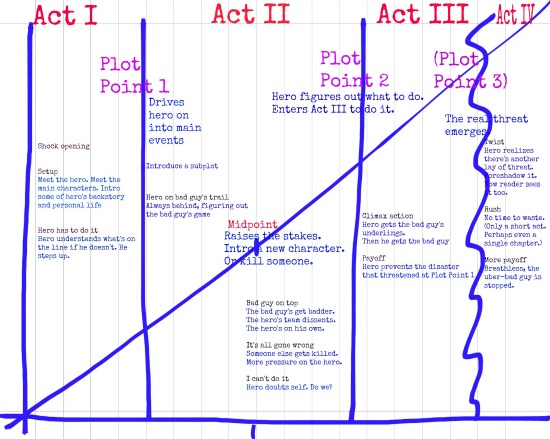
Plot A Thriller Diagram: Matt Rees Writing Techniques


Text excerpt written by Matt Rees:


This diagram is a framework for writing a thriller. It’s based on my experience writing crime fiction and on studying how other writers create thriller plots. I’ll go into more detail about each of the stages of the diagram in future posts on thriller plot structure and thriller plot twists, and I’ll add some points to the diagram as we go along. But if you follow this to create your thriller plot outline, you’ll have a thriller that’ll keep you and your readers in a state of tension until the last page. It’s a companion piece to my podcast How to Structure and Plot a Book. While you’re waiting for my coming posts, come up with a premise for a thriller and see if you can plot out how you’d develop it right through this diagram. Before you know it you’ll have a basic thriller plot. Let me know what you come up with.

Tuesday, June 30, 2015

University of Chicago: Writing in College with Links

The University of Chicago has some great reference material for students making the transition from high school to college writing.  I have included links to some of the free materials, but I would urge students to go to the following link and search for information pertinent to their individual needs.

Here is a link to the main site for Writing in College:
http://writing-program.uchicago.edu/resources/collegewriting/*


This is a link to the Chapter 1 PDF, which is a great starting point with a ton of useful information:

Chapter 1: PDF*

*Writing in College is licensed under a Creative Commons Attribution Non-Commercial No Derivativeslicense. You may use and share this essay and/or its chapters for non-commercial educational purposes, provided that you give credit to the authors (Joseph M. Williams and Lawrence McEnerney) and reproduce this notice.

Monday, April 20, 2015

"Taking the Mystery Out of Writing Mysteries": Informative Article by Dennis Palumbo

Full Article by Dennis Palumbo

The following italicized sections are from the article and I posted them because they contain some great brainstorming questions for beginning a mystery novel. Please click the link above to review the article in its entirety.
For me, there's only one answer: ask yourself, what makes you unique? What scares you, interests you, makes you angry? What do you yearn for, or wish to avoid? What are your hobbies, passions? What's the aspect of your own character about which you're most conflicted, unhappy, even embarrassed? Believe it or not, this is where the seeds of an interesting, unusual protagonist are first sewn.


AND

So why don't you start by making a list of your own traits and interests, as suggested above? The closer the hero or heroine of your mystery story is to you, the more vivid and engaging he or she will be to the viewer. After all, as Emerson said, "To know that what is true for you in your private heart is true for everyone - that is genius."


Next, let's look at the world of your mystery story. What is the world you inhabit? Suburban soccer mom or single father? Former football coach, magazine editor, or Rhodes scholar? Travel agent, computer specialist, or kindergarten teacher?


After all, you know the details of your particular world so clearly. You know the ins and outs. It's those details that create the backdrop for the crime, that make possible the intrigue, the collision of misleading, back-stabbing, or too-good-to-be-true characters. Think of the gambling background in the movieOcean's 11. Or that of the legal profession in The Firm.

Wednesday, December 17, 2014

Open Courses from Harvard are Free

Check out Harvard's free courses from open-learning-initiative.

I am very interested in open source education and have posted about MIT and other institutions offering open sources courses. The main theme behind open sources courses makes sense because it offers education and higher learning from elite institutions for free. They aren't going to charge us for knowledge in the near future...I promise.

Thursday, December 11, 2014

English Teacher's Guide to Transforming your classroom environment into a writing workshop

Step 1: Transforming your English Classroom into a Writing Workshop
  • Have the fellow writers in your classroom create a journal, and supply each of them with a pencil. 
  • Start each class day by habitual journaling* see definition below
  • Feel free to start with a prompt from this pdf.(collected off the internet, compiled by Liz Daniell)
  • After 5-7 minutes of journaling, change the classroom design into a circular seating arrangement and ask for volunteers to share their journal. Feel free to get the sharing started by sharing your journal.
  • Comment (Print, distribute, discuss, and model response using Peter Elbow's Responding to Writing pdf.)
  • Share your results, observations, successes and failures under this post's comments. I will respond to all comments.
*habitual journaling-beginning each class period with a 5-7 minute free write.  Have students journal about things they care about such as:
  • hobbies
  • food
  • travel
  • movies
  • games
  • social media
  • the topics are endless
  • If your are struggling for ideas, please see the prompts pdf. above, or do a search for: "daily writing prompts".

Quote from Peter Elbow's Writing Without Teachers

Writing Without Teachers. Elbow contends there is "a place where there is learning but no teaching. It is possible to learn something and not be taught. It is possible to be a student and not have a teacher." (ix). Teachers are "more useful when it is clearer that they are not necessary." (x). The role of the teacher is to be useful, it is not the teachers role to provide instructions and directions but to help the student do in a more lucid and powerful way what she is already fully capable of doing.


via http://myweb.wvnet.edu/~jelkins/writeshop/writeshop/elbow.html

Tuesday, December 9, 2014

Link to Writer's Resource Center, POEWAR.COM and Flogging the Quill

http://www.poewar.com/archive/

This database is a great resource for individuals interested in writing.

Another great site for aspiring writers is http://www.floggingthequill.com/.
I especially like the exercise on trapping your audience or editors in the first page, and the technical
guidelines discussion concerning sending in your work.

Your Story 63: Submit Now!WritersDigest.com | WritersDigest.com

Your Story 63: Submit Now!WritersDigest.com | WritersDigest.com


Submit a story of 750 words or less based on the following image: